
Earth Leakage Measurement - New 18th Edition Regulation
How often have you spent hours fault finding Nuisance Tripping for free? Wondering, if only I knew there was an issue before I quoted for this Distribution Board upgrade?
There is a new 18th edition regulation identifying the requirement for you to measure Earth Leakage, as stated in BS7671 Reg 531.3.2. In a nutshell, each electrician must check that each install completed does not have excessive leakage to earth on each of the RCDs or RCBOs. The maximum permitted value per RCD has been set at 30% of the nominal value, i.e. a 30mA RCD would be no more than 9mA, 100mA would be 30mA and so on. Nonetheless, I am sure you would find it useful to know if there is a potential issue on an installation before you quote for your next Distribution Board change.
“The only way to indicate the presence of Earth Leakage would be to use an Earth Leakage Current Clamp Meter”
The Di-LOG DL6518 Earth Leakage Clamp is a low-cost solution that works on differential leakage measurement, which involves simultaneously clamping around the live and neutral conductors together. You can check any installation by simply clamping around your meter tails on the supply. The DL6518 has a measurement resolution of 100µA (0.1mA) making measurement very accurate when measuring minimal AC currents.
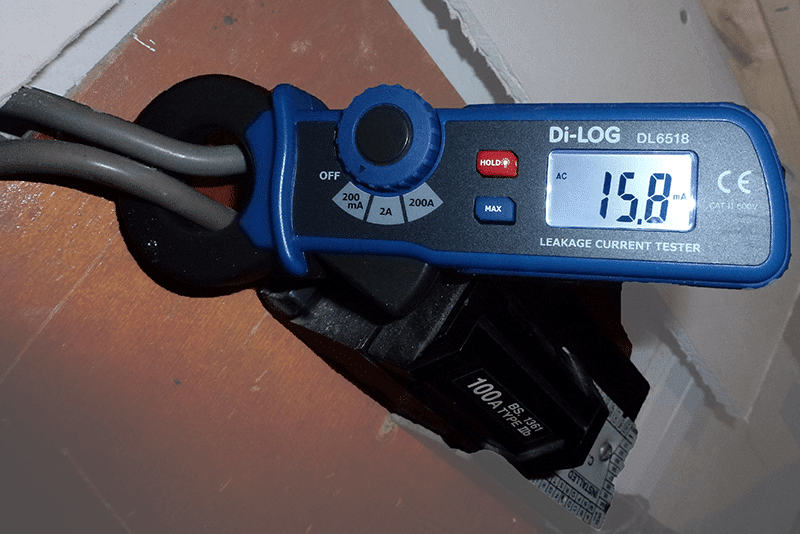
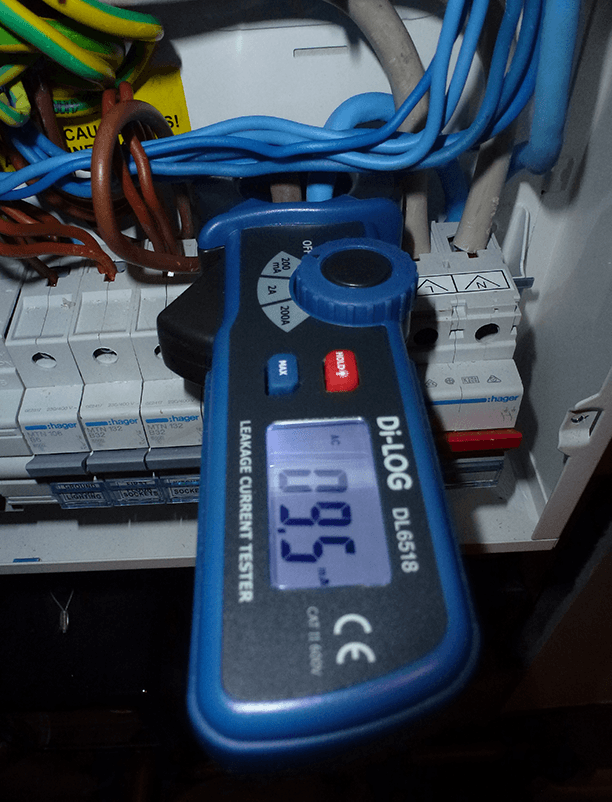
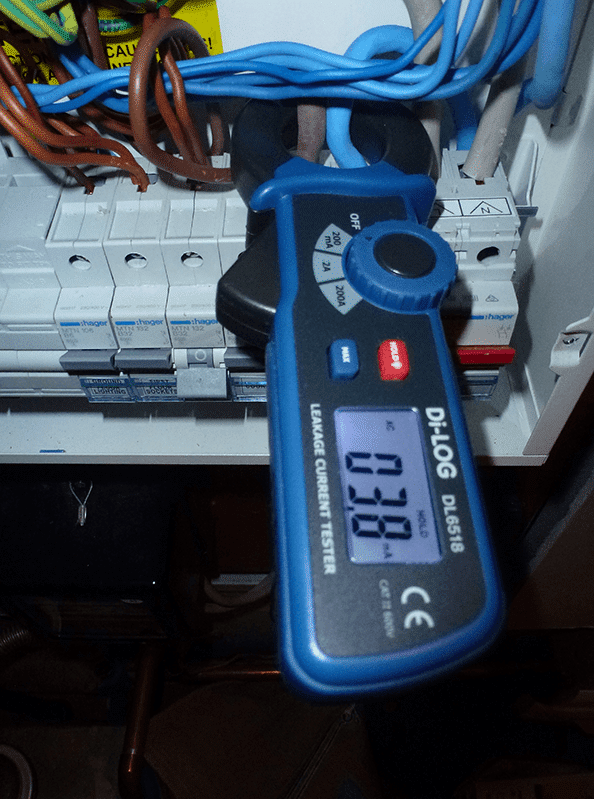
Domestic installations tend to have dual 30mA RCDs fitted or even made up entirely of RCBOs. If the installation shows a combined differential leakage current above 30% of each RCD/RCBO value, in this case 9mA, you may need to take action to manage the leakage to earth and minimise the likelihood of Nuisance Tripping. You all know how costly call outs are to any business to reset or investigate tripping RCD. Where possible, you will need to have the day to day electrical appliances in operation to accurately determine potential issues. If excessive leakage is then identified on the tails, you would then in turn need to clamp around the live and neutral conductors of each of the RCDs to determine if the leakage on that RCD is above the 30% threshold, ideally looking for a current considerably less than 9mA, repeat for each RCD.
Intentional or Unintentional Leakage
If the Earth Leakage detected on each RCD is excessive, the user will need to ask the question “Is this intentional or un-intentional?”. Intentional Earth Leakage tends to be found in electrical appliances in the form of a functioning earth, where a small amount of earth leakage is required for the appliance to function. Unintentional Earth Leakage tends to occur in poor installations where there could be a breakdown in the conductor insulation, moisture ingress, amongst many other causes.
Identification
Switching each individual circuit off, one by one is a good area to start, here you can easily identify which circuit you may need to investigate further. Once a circuit is identified, eliminate the Intentional leakage first by switching of each individual appliance one by one to see if this changes the result. Every electrical appliance has a “Protective Earth Conductor current” limit please refer to the “In service Inspection and Testing” Code of Practice for more information on these limits. If the isolating of electrical appliances does not change the result, it may well be unintentional leakage, and a check of the insulation of the conductors will be required in the form of an Insulation Test.
Leakage Management
There is an array of options to manage your Earth Leakage, balancing circuits between RCDs to fall below the 30% threshold, fitting RCBOs, Testing the electrical appliances or even a complete re-wire… all are critical when you price your next job!